


What is the role of an encoder in automation systems?
Nov 20, 2025
Leave a message
In the realm of automation systems, encoders play a pivotal and multifaceted role. As an encoder supplier, I've witnessed firsthand how these devices are the unsung heroes that enable the precise and efficient operation of various automated processes. This blog will delve into the significance of encoders in automation systems, exploring their functions, types, and real - world applications.
Understanding Encoders
Encoders are devices that convert motion into an electrical signal. They are used to measure the position, speed, and direction of a rotating or linear object. In an automation system, this information is crucial as it allows the system to make informed decisions and perform tasks with high precision.
There are two main types of encoders: rotary encoders and linear encoders. Rotary encoders are used to measure the rotation of a shaft, while linear encoders are used to measure linear displacement. Each type has its own unique applications and advantages.
The Role of Encoders in Automation Systems
Position Feedback
One of the primary roles of encoders in automation systems is to provide accurate position feedback. In a robotic arm, for example, encoders are used to determine the exact position of each joint. This information is then sent to the control system, which can adjust the movement of the arm accordingly. Without encoders, the robotic arm would not be able to perform tasks with the required precision.
In a CNC (Computer Numerical Control) machine, encoders are used to monitor the position of the cutting tool. This ensures that the machine can produce parts with the exact dimensions specified in the design. The TS2613N11E1 Resolver Encoder Brushless is a great example of an encoder that can provide highly accurate position feedback in such applications. It is a brushless resolver encoder, which means it has no brushes to wear out, resulting in a longer lifespan and more reliable operation.
Speed Control
Encoders also play a crucial role in speed control. In a conveyor belt system, for instance, encoders are used to measure the speed of the belt. This information is used by the control system to adjust the motor speed, ensuring that the belt moves at a constant and desired speed. If the speed of the conveyor belt is not properly controlled, it can lead to issues such as product jams or uneven product flow.
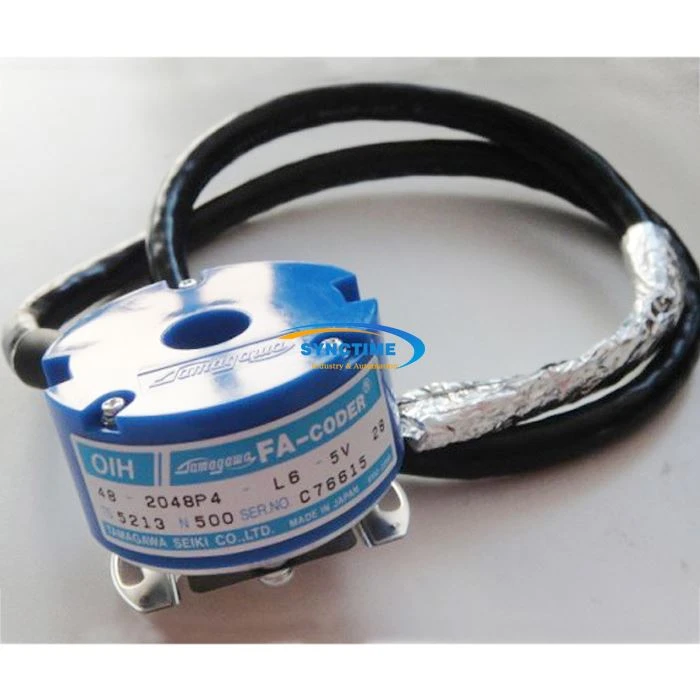
The TS5213N500 OIH48 - 2048P4 - L6 - 5V Encoder is well - suited for speed control applications. It has a high resolution of 2048 pulses per revolution, which allows for precise speed measurement. With this encoder, the control system can make accurate adjustments to the motor speed, maintaining a stable and efficient operation of the conveyor belt.
Direction Detection
In addition to position and speed, encoders can also detect the direction of motion. In a servo motor system, for example, encoders are used to determine whether the motor is rotating clockwise or counterclockwise. This information is essential for the control system to ensure that the motor moves in the correct direction and performs the desired task.
The 0541113 AD36/1213AF.0RBIB - D0 Encoder Hengstler is capable of providing direction detection. It can accurately sense the direction of rotation, allowing the control system to make appropriate decisions and ensure the proper functioning of the servo motor.
Real - World Applications of Encoders in Automation
Manufacturing
In the manufacturing industry, encoders are used in a wide range of applications. In assembly lines, encoders are used to control the movement of robots and conveyors, ensuring that products are assembled accurately and efficiently. In packaging machines, encoders are used to measure the length of the packaging material and control the speed of the cutting mechanism, resulting in precise and consistent packaging.
Renewable Energy
In the renewable energy sector, encoders are used in wind turbines and solar tracking systems. In wind turbines, encoders are used to measure the position and speed of the blades, allowing the control system to optimize the power output by adjusting the pitch of the blades. In solar tracking systems, encoders are used to determine the position of the sun and adjust the orientation of the solar panels accordingly, maximizing the amount of sunlight captured.
Automotive
In the automotive industry, encoders are used in various applications such as engine control, transmission control, and anti - lock braking systems (ABS). In engine control, encoders are used to measure the position of the crankshaft and camshaft, allowing the engine control unit (ECU) to optimize the fuel injection and ignition timing. In ABS, encoders are used to measure the speed of each wheel, enabling the system to prevent wheel lock - up during braking, improving vehicle safety.
Advantages of Using Encoders in Automation Systems
There are several advantages to using encoders in automation systems. Firstly, encoders provide high - precision measurement, which is essential for tasks that require accuracy. Secondly, encoders are reliable and durable, with many models having a long lifespan and low maintenance requirements. Thirdly, encoders can improve the efficiency of automation systems by providing real - time feedback and enabling precise control of motion.

Conclusion
In conclusion, encoders are an integral part of automation systems. Their ability to provide accurate position, speed, and direction information is crucial for the precise and efficient operation of various automated processes. As an encoder supplier, I understand the importance of providing high - quality encoders that meet the specific needs of different applications.
If you are in need of encoders for your automation system, whether it's for a manufacturing plant, a renewable energy project, or an automotive application, we are here to help. Our range of encoders, including the TS2613N11E1 Resolver Encoder Brushless, TS5213N500 OIH48 - 2048P4 - L6 - 5V Encoder, and 0541113 AD36/1213AF.0RBIB - D0 Encoder Hengstler, offers high performance and reliability. Contact us today to discuss your requirements and explore how our encoders can enhance the performance of your automation system.
References
- "Encoder Handbook" by H. K. D. H. Bhadeshia.
- "Automation Technology: Fundamentals and Applications" by Michael J. Durfee.
- Industry whitepapers on encoder applications in manufacturing, renewable energy, and automotive sectors.
Send Inquiry