


How to calculate the electric field inside a charged cylindrical conductor?
Jan 20, 2026
Leave a message
Hey there! As a cylinder supplier, I often get asked about all sorts of technical questions related to cylinders, especially those about the electric field inside a charged cylindrical conductor. It might seem super complicated at first, but trust me, with a bit of breakdown, it's not as hard as it seems.
Let's start with the basics. A charged cylindrical conductor is just what it sounds like – a cylinder that has an electric charge on it. To calculate the electric field inside this thing, we're gonna need to lean on some fundamental concepts from electrostatics.
First off, we've gotta talk about Gauss's Law. It's a cornerstone when it comes to figuring out electric fields. Gauss's Law states that the electric flux through a closed surface is equal to the total charge enclosed by that surface divided by the permittivity of free space (ε₀). Mathematically, it's written as ∮E⋅dA = Q_enclosed/ε₀.
Now, let's picture our charged cylindrical conductor. We're gonna assume it's infinitely long (this simplifies things a ton) and has a uniform charge distribution on its surface. For an infinitely long cylinder, the electric field has a radial symmetry, meaning it points either directly inward or outward from the axis of the cylinder, and its magnitude only depends on the distance from the axis.
To use Gauss's Law, we need to pick a Gaussian surface. For our cylindrical conductor, a good choice is a co - axial cylinder. Let's say we have a cylinder of radius r (the distance from the axis of the conductor where we want to find the electric field) and length L.
The electric flux through the Gaussian surface has three parts: the two circular ends and the curved surface. Since the electric field is radial, the electric field vector E is perpendicular to the normal vector of the circular ends. So, the electric flux through the circular ends is zero (because E⋅dA = 0 as the angle between E and dA is 90 degrees).
The electric flux through the curved surface of the Gaussian cylinder is ∮E⋅dA = E∮dA (because the electric field is constant over the curved surface and parallel to the normal vector dA). The area of the curved surface of our Gaussian cylinder is A = 2πrL. So, the electric flux through the curved surface is E(2πrL).
Now, we need to find the enclosed charge. If the cylinder has a linear charge density λ (charge per unit length), the charge enclosed by our Gaussian cylinder of length L is Q_enclosed = λL.
Applying Gauss's Law, E(2πrL)=λL/ε₀. We can cancel out the length L from both sides of the equation, and we get E = λ/(2πε₀r).
But, hold on! What if we're talking about the electric field inside the charged cylindrical conductor? Well, a cool property of conductors in electrostatic equilibrium is that the electric field inside them is zero. Why is that? When we have a conductor, the free charges can move around. If there was an electric field inside, the charges would keep moving until the net electric field became zero. So, for r < R (where R is the radius of the charged cylindrical conductor), E = 0.
For r > R, we use the formula E = λ/(2πε₀r), where λ is the total linear charge on the conductor.
Now, as a cylinder supplier, I know that different applications might need different types of cylinders. For instance, if you're looking for a reliable cylinder for general - purpose pneumatic applications, you might be interested in the MGPM12 - 100Z Cylinder. It's got a great reputation for being durable and performing well under normal operating conditions.
If you need a bit more power and a different stroke length, the MGPM20 - 125Z Cylinder could be a perfect fit. It's designed to handle more demanding tasks while still maintaining precision.
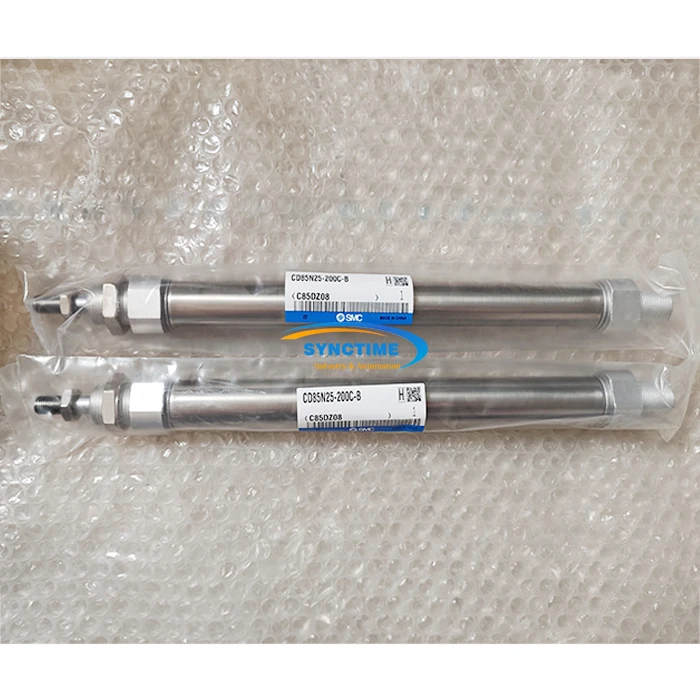
And for those really heavy - duty applications, the CD85N25 - 200C - B Cylinder is a beast. It can withstand high pressures and repeated use without breaking a sweat.

Whether you're an engineer working on a complex project or a DIY enthusiast looking for the right cylinder, having a good understanding of the technical aspects like calculating the electric field inside a charged cylindrical conductor can be super helpful. It gives you a better grasp of how cylinders interact with different physical phenomena.
If you're in the market for cylinders and have questions about which one is right for your project, or you just want to learn more about the technical details, don't hesitate to reach out. We're here to help you make the best choice for your needs. Whether it's for a project that involves electrostatics or just a simple mechanical application, we've got a wide range of cylinders to offer.
So, let's start a conversation and see how we can work together to get the perfect cylinders for your next venture.
References:
- Halliday, D., Resnick, R., & Walker, J. (2014). Fundamentals of Physics. Wiley.
- Griffiths, D. J. (2017). Introduction to Electrodynamics. Cambridge University Press.
Send Inquiry