


What is the capacitance of a cylindrical capacitor?
Dec 18, 2025
Leave a message
Hey there! As a cylinder supplier, I often get asked about all sorts of technical stuff related to cylinders. One question that pops up from time to time is about the capacitance of a cylindrical capacitor. So, let's dive right into it and break down what this capacitance thing is all about.
First off, what's a cylindrical capacitor? Well, it's a type of capacitor made up of two co - axial cylinders. You've got an inner cylinder and an outer cylinder. The space between these two cylinders is usually filled with a dielectric material, which can be something like air, paper, or a special insulating plastic.
Now, to understand capacitance, we need to know a bit about what a capacitor does. A capacitor is a device that stores electrical energy in an electric field. It's kind of like a little battery that can charge up and then release that stored energy when needed. The capacitance (C) of a capacitor is a measure of how much electrical charge (Q) it can store per unit of voltage (V) across its plates. In simple terms, C = Q/V.
For a cylindrical capacitor, the formula to calculate its capacitance is a bit more involved. The capacitance of a cylindrical capacitor with length (L), inner radius (a), outer radius (b), and filled with a dielectric of permittivity (\epsilon) is given by:
(C=\frac{2\pi\epsilon L}{\ln(\frac{b}{a})})
Let's break down this formula a bit. The (2\pi) is just a constant that comes from the geometry of the cylinder. The (\epsilon) is the permittivity of the dielectric material between the two cylinders. Permittivity is a measure of how easily an electric field can pass through a material. Different materials have different permittivities. For example, air has a relatively low permittivity, while some special ceramics can have very high permittivities.
The (L) in the formula is the length of the cylinders. The longer the cylinders, the more area there is for the electric field to interact with the dielectric, and thus the higher the capacitance. The (\ln(\frac{b}{a})) term in the denominator is the natural logarithm of the ratio of the outer radius ((b)) to the inner radius ((a)). As the difference between the outer and inner radii gets larger, the value of (\ln(\frac{b}{a})) increases, and the capacitance decreases.
Let's look at an example. Suppose we have a cylindrical capacitor with an inner radius (a = 1) cm, an outer radius (b = 2) cm, a length (L = 10) cm, and the dielectric between the cylinders is air, which has a permittivity (\epsilon=\epsilon_0\approx8.85\times 10^{-12}\ F/m). First, we need to convert the lengths to meters. So, (a = 0.01\ m), (b = 0.02\ m), and (L = 0.1\ m).
Now, we calculate (\ln(\frac{b}{a})=\ln(\frac{0.02}{0.01})=\ln(2)\approx0.693). Then, using the formula (C=\frac{2\pi\epsilon L}{\ln(\frac{b}{a})}), we substitute the values:
(C=\frac{2\pi\times8.85\times 10^{-12}\times0.1}{0.693}\approx8\times10^{-12}\ F = 8\ pF)
So, this particular cylindrical capacitor has a capacitance of about 8 picofarads.
Now, as a cylinder supplier, we offer a wide range of cylinders that can be used in various applications, including those where cylindrical capacitors might be involved. For example, we have the MGPM12 - 100Z Cylinder. This cylinder is known for its high - quality construction and reliable performance. It can be used in many industrial setups where precise movement and control are required.
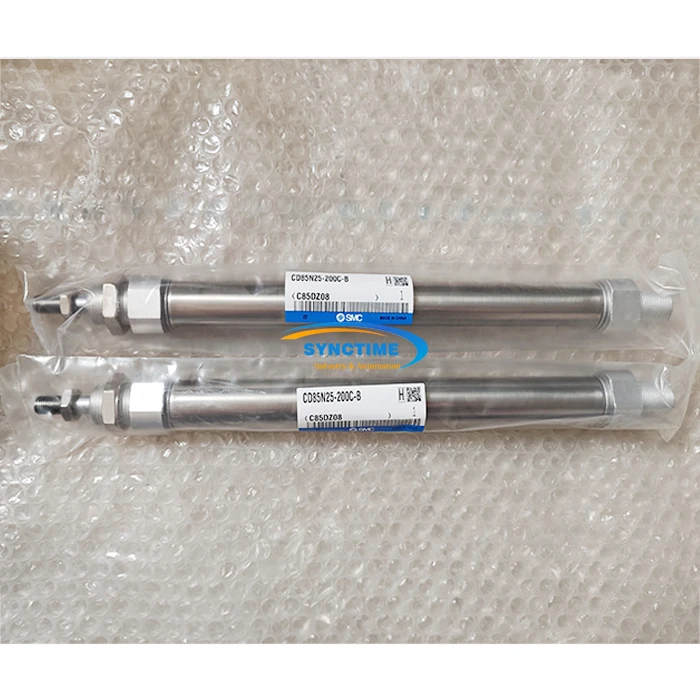
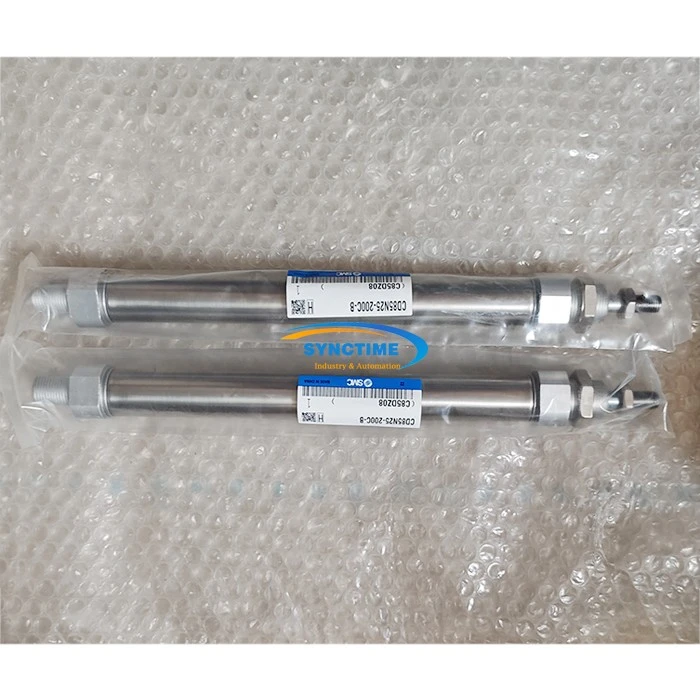
Another great option is the CD85N25 - 200C - B Cylinder. This cylinder is designed to handle more demanding tasks and can operate under higher pressures. It's a workhorse in many manufacturing and automation processes.
And if you need a cylinder with a different set of specifications, we also have the MGPM20 - 125Z Cylinder. This one offers a good balance between size and performance, making it suitable for a variety of applications.
Whether you're working on a project that involves cylindrical capacitors or just need a reliable cylinder for other purposes, we've got you covered. Our cylinders are made with the highest quality materials and go through rigorous testing to ensure they meet the highest standards.
If you're interested in learning more about our cylinders or have any questions about capacitance or other technical aspects, don't hesitate to reach out. We're here to help you find the right solutions for your needs. Contact us to start a procurement discussion and let's work together to get you the cylinders you need for your projects.
References
- Serway, R. A., & Jewett, J. W. (2018). Physics for Scientists and Engineers with Modern Physics. Cengage Learning.
- Halliday, D., Resnick, R., & Walker, J. (2013). Fundamentals of Physics. Wiley.
Send Inquiry